Metal wire frames are strong, light and need a liner. Wicker and rattan look best and last longest under cover rather than in the weather. Plastic is cheapest, holds water well and needs no liner, but looks the most obviously manufactured.
These three cover almost every hanging basket sold, and they are genuinely different products rather than three finishes of the same thing.
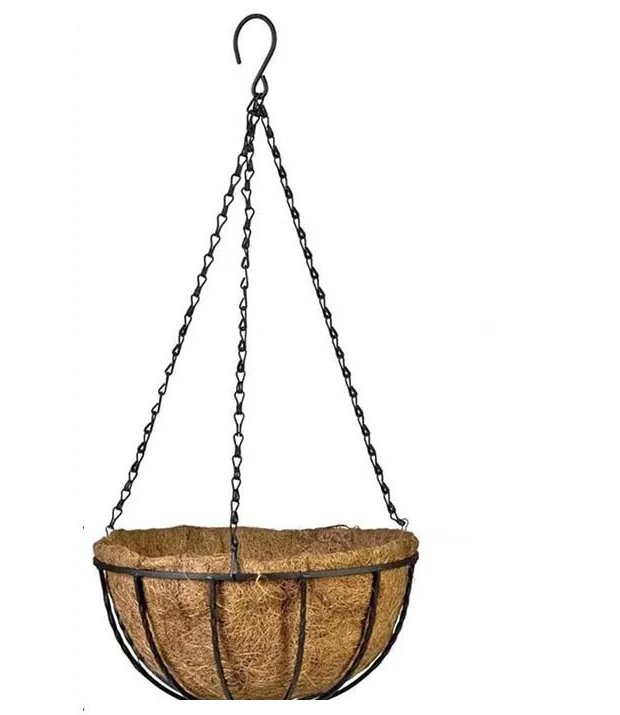
Metal wire frames
What it is: an open frame of coated steel wire, which needs a liner to hold compost.
Strengths: strong for its weight, so a large basket does not start heavy. The open structure means excellent drainage and air to the roots, and it is the traditional look most people picture.
Weaknesses: needs a liner, which is a consumable. Dries out fastest of the three, because air reaches the sides.
Watch for: rust where the coating is chipped, usually at the rim - the metal range covers those.
Wicker and rattan
What it is: woven natural or synthetic fibre, either as a solid basket or a frame.
Strengths: by some distance the best-looking, with real texture that a moulded pot cannot match. It suits period houses and softens a modern wall.
Weaknesses: natural wicker is the least weather-tolerant of the three. Constant wet and hard frost shorten its life considerably, and it is the heaviest before you add anything.
Watch for: whether it is natural or synthetic rattan. Synthetic looks similar and lasts far longer outdoors - the wicker and rattan range covers both, and the buyer's guide covers the look.
Plastic
What it is: a moulded pot or basket, usually with drainage holes and often a built-in reservoir.
Strengths: cheapest, lightest, entirely weatherproof, holds water considerably better than an open frame, and needs no liner at all.
Weaknesses: looks manufactured, and cheap plastic can go brittle after a couple of cold winters. No side planting, since there is nothing to plant through.
Watch for: UV degradation on cheap examples, which shows as chalky, faded surfaces - the plastic range covers them.
Which dries out fastest
A practical ranking, since watering is the main burden.
Metal wire with a coco or moss liner dries fastest, because air reaches the compost from every side.
Wicker is in the middle, depending on how tight the weave is.
Plastic holds water longest, because the sides are solid - the care guide covers the routine.
Which lasts longest outdoors
Reverse the order, roughly. Good plastic and coated metal will do many years. Natural wicker outdoors is a two or three season material unless it is sheltered.
Synthetic rattan sits with the plastics for durability and with wicker for looks, which is why it exists.
Side planting
The thing that decides how full a basket looks, and only two of the three allow it.
A wire frame with a liner lets you plant through the sides, which is what fills the space between rim and base. Wicker frames often do too. A solid plastic pot does not - you get a top display only.
If a full ball of flowers is the goal, that points at wire - the planting guide covers the technique.
Weight, empty and full
Empty: plastic lightest, metal next, wicker heaviest.
Full and watered: the differences narrow, because compost and water dominate. Where material weight matters most is the empty starting point on a doubtful fixing - the hanging guide covers the load.
Winter
Metal and plastic can stay out. Natural wicker should come in, or at least go somewhere sheltered, and its life roughly doubles if it does - the winter range covers what goes up instead.
Very cheap plastic is the one to watch in a hard frost, as it can crack - the winter range covers what copes with it.
Cost over time
Plastic is cheapest to buy and cheapest to run, since there is no liner to replace.
Metal is mid-price and has an annual liner cost. Wicker costs most and lasts least outdoors, which is the honest trade for how it looks.
Which to buy for what
| Situation | Material |
|---|---|
| Traditional full ball of flowers | Metal wire with a liner |
| Front door of a period house | Wicker or synthetic rattan |
| Exposed, wet or high position | Plastic or coated metal |
| Lowest maintenance | Plastic with a reservoir |
| Under a porch, sheltered | Natural wicker |
| Doubtful fixing | Plastic, lightest empty |
Liners, briefly
Only relevant to the first two. Coco and moss look best; a liner with a membrane behind it holds water considerably longer - coco liners and the liners range cover them.
What we would suggest
A coated wire basket with a good liner for a classic planted display, and plastic where the position is difficult or you want the least work.
Wicker where it will be seen close up and can be sheltered - the full basket range covers all three, with free UK delivery over £20.
The short version
- Metal wire is strong and light, needs a liner, and dries out fastest of the three.
- Wicker looks best and lasts least outdoors - synthetic rattan bridges the gap.
- Plastic is cheapest, holds water longest and allows no side planting at all.
- Side planting is what fills a basket, and only wire and open frames allow it.
- Natural wicker roughly doubles its life if it comes in over winter.
Frequently asked questions
Which hanging basket material lasts longest?
Good plastic and coated metal will do many years outdoors. Natural wicker is a two or three season material unless it is sheltered, though synthetic rattan lasts far longer while looking similar.
Which material dries out fastest?
Metal wire with a coco or moss liner, because air reaches the compost from every side. Wicker sits in the middle depending on the weave, and solid plastic holds water longest.
Can I plant through the sides of any basket?
Only open ones - a wire frame with a liner, and many wicker frames. A solid plastic pot gives you a top display only, which is why wire is the choice if you want a full ball of flowers.
Is plastic a bad choice?
Not at all - it is cheapest, lightest, fully weatherproof, holds water best and needs no liner. It looks manufactured, and cheap examples can go brittle after a couple of cold winters, but it works.
Which should I buy for a front door?
Wicker or synthetic rattan if it is sheltered and will be seen close up, since it looks considerably better. Coated metal or plastic if the spot is exposed, wet or high up.